

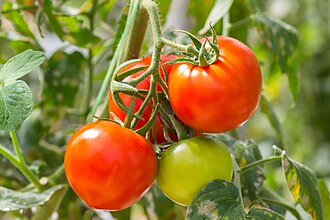
Have you planted tomatoes in your garden or windowsill pots yet? You might even be on your second planting by now. Statistically, 55 percent of American households have a garden. About 43 percent of those gardens grow food, and tomatoes are planted in 86 percent of food gardens. In fact, Americans eat about 1 billion pounds of tomatoes annually. With over 10,000 varieties to choose from in a cornucopia of colors, tomatoes could be called an all-American fruit. Or are they vegetables?
Tomato Trivia
Tomatoes originally grew wild near the Andes mountains. Over time indigenous people brought the plant they called tomatl north through Central America and into Mexico. The tomatl was used in cooking and as a gift for newlyweds to promote fertility.
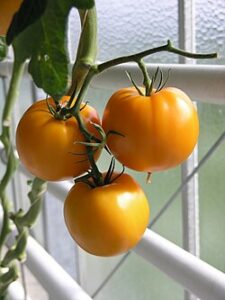
When Spanish conquistadors arrived in Mexico in the early 16th century, they called the food tomate. It is said Cortez discovered the fruit in Montezuma’s gardens and brought the seeds back to Spain. The first variety of tomato to reach Europe was probably yellow, leading to the name poi d’oro, or yellow apples.
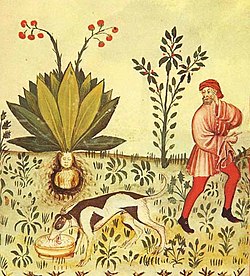
Over time, the plant made its way further into Europe, most commonly as an ornamental plant. The new plant had several names. In 1544 Italian herbalist Pietro Andrea Mattioli classified the tomato as a nightshade and a mandrake. Mandrakes were known as aphrodisiacs, which may be why the French called the new fruit a love apple —the pomme d’amour—or golden apple. This potentially scandalous application limited the number of people willing to try the new food.
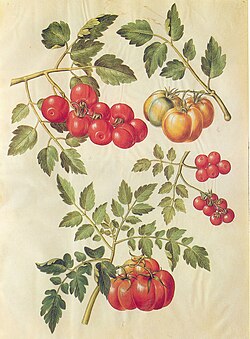
Many thought the new plant was poisonous, and called the fruit a poison apple. In fact, the leaves, stems and roots of the tomato plant contain solanine, a neurotoxin and should not be eaten. The tomato plant is also a relative of deadly nightshade. Botanist Joseph Pitton De Tournefort gave the new fruit its official name of Lycopersicon esculentum. The moniker translates as edible wolf peach. Peach because the fruit was round, and was thought to be the poison Galen referred to in the 3rd century when discussing ways to entice and then kill unwanted wolves.
Alternatively, German myths claimed that witches used mandrake and nightshade to summon werewolves. And the earliest German name for tomatoes was Wolfpfirsich which translates to wolf peach. Later in the 18th century, Carl Linnaeus modified the translation of Lycopersicon esculentum to “edible wolf peach.”
Some people tried the fruit, and lived to tell the tale. But, the didn’t care for the taste or the smell. In 1597 English botanist John Gerard declared tomatoes were corrupt and of rank & stinking savor.
However, these technical details were not why people thought the tomato was poisonous. Many upper class Europeans died after consuming tomatoes, proving it was better not to eat the fruit, no matter how delicious it looked. It turns out this was a false association. Upper class Europeans ate off of pewter plates, and acidic tomatoes leeched lead out of the pewter. Thus wealthy diners died from lead poisoning after consuming tomato based dishes off pewter dishes. Sometimes common pottery makes the best dinnerware.
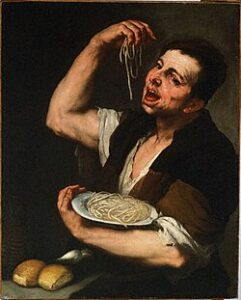
But tastes change. In the 19th century Italians began using tomatoes in their pasta dishes. Previously, Italians had used lardo, the pig back fat that was a byproduct of processing prosciutto, with their pasta dishes. But in the 19th century, pig farmers changed to a different breed that produced a leaner prosciutto. The lardo, however, did not taste as good as before. Italian cooks began experimenting and settled on tomato based sauces to accompany pasta dishes.
Over time, tomatoes became better known in North America. Maria Parloa’s 1872 Appledore Cook Book included an early recipe for Tomato Soup.

Peel & slice tomatoes enough to fill a two-quart basin. Put them into the soup kettle with six quarts of water & 2 pounds of beef. Boil 3 hours. Season with pepper, salt & and spoonfuls of butter. Strain. Serve with toasted bread.
During the tomato’s checkered history, it was considered a fruit. The story of how the tomato became a vegetable is in my next blog.
Illustrations & A Few Sources
Garden Tomatoes by Mdmad1234; Yellow Tomatoes by Goldilocks; Tacuinum Sanitation Mandrake Dog c. 1390; Tomatoes, gouache on vellum by Hans-Simon Holtzbecker, 17th century; Pasta Eater: Allegory of Taste by Luca Giordano, 17th Century; Illustration from the original Appledore Cook Book; Bowl of Tomato Basic Soup by Srujanabotcha. Jacqui. “Neapolitan Zita Pasta with Italian Lardo.” the Pasta project. Feb. 23, 2022. Peggy Trowbridge Filippone. “The History of Tomatoes as Food.” The Spruce Eats. Dec. 28 2022. Dale E Hammerschmidt & Michael J. Franklin. “The Edible Wolf Peach.” Translational Research. Vol. 146, Issue 4, October 2005.
If you would like to be notified about out my blogs as they appear, sign up for my newsletter. In addition to the link to my latest blog, the newsletter includes news about my writing and publishing.