

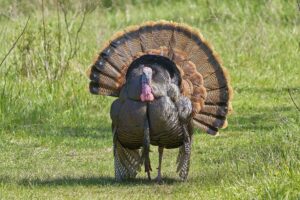
Today’s blog is about Wild Turkeys, not the birds that appear on Thanksgiving dinner tables.
The forebears of this handsome fellow on the left were first domesticated in Mexico about 2,000 years ago. Spanish traders brought the bird to Europe and Asia via shipping routes that took them through Turkey, which is why Europeans dubbed this new bird a turkey. At a time when people regularly ate storks, herons, and ground birds called bustards, the meaty turkey caused a sensation.
When Europeans first arrived in North America, they were surprised to find the same bird they ate at home living in America and dining on a diet of chestnuts, beechnuts, and walnuts.
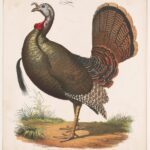
Officially, this native North American bird is Meleagris gallopavo. He can weigh up to 20 pounds with a wingspan of 5 feet, which may explain why he can fly at a speed of 50 miles an hour. Alternatively, he can walk up to 18 miles an hour.
By the early 19th century, turkeys were an economical food source. The eggs hatched in the spring, and the birds were ready for slaughter in the fall. One bird prepared with side dishes could feed an entire family.
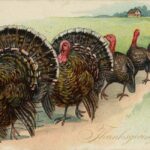
Farms that specialized in turkey production had willing buyers in the city. The only challenge was how to get the turkeys to market, and the answer was turkey drives. Turkey flocks could cover 10-12 miles a day before stopping for the night. They consumed food as they walked, often grasshoppers. And drovers brought corn with them in case food sources ran short.
The only challenge was darkness, whether from a cloud, a rainstorm, a covered bridge or sunset. Turkey drives continued into the 20th century until selective breeding of the Broad-Breasted White Turkey produced an animal too heavy to walk long distances. Transportation resources had also improved.
Benjamin Franklin, The Great Seal & Our National Bird
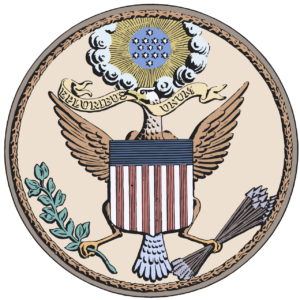
At some point during the days leading up to Thanksgiving, someone remembers that Founding Father Benjamin Franklin thought the Wild Turkey should have become the national bird of America. As it turns out, Franklin did not actually say this. He said, in reference to the Society of Cincinnati, that their mascot should have been the turkey, not the eagle. So, here’s the real story.
On July 4, 1776, the American Continental Congress signed the Declaration of Independence. Congress then appointed Benjamin Franklin, John Adams, and Thomas Jefferson to design an official seal for the United States. Official seals are important for two reasons. First, the seal is the symbol of a sovereign state. Congress wanted to make the United States’ new status clear. Secondly, the Great Seal is a signature stamp that is on all official documents. No doubt, members of the Continental Congress hoped the design would be done quickly. But the committee members did not gain congressional approval of their design. Two other committees also submitted designs, without gaining approval.
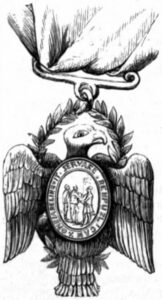
Finally the designs were given to Charles Thomson, secretary of the Congress. He combined the drawings and selected the Bald Eagle as a symbol of America. Like the Wild Turkey, the Bald Eagle was a Native American bird. Unlike the turkey, eagles had a long history as a symbol of strength.
In a letter to his daughter Sally, Ben Franklin expressed some dismay at the Bald Eagle’s elevation, but he was not referring to the Great Seal. The new hereditary Society of Cincinnati for veterans of the revolutionary war was founded in 1783. Perhaps in imitation of the Great Seal, the Society adopted the Bald Eagle as its symbol. Franklin did not believe in hereditary societies, and was poking fun at the Society’s new symbol. But even though he was not speaking about the Great Seal, Franklin’s assessment could apply to both the Society of Cincinnati and the national bird.
“I wish the Bald Eagle had not been chosen the Representative of our Country. He is a Bird of bad moral Character. He does not get his Living honestly. You may have seen him perched on some dead Tree near the River, where, too lazy to fish for himself, he watches the Labour of the Fishing Hawk; and when that diligent Bird has at length taken a Fish, and is bearing it to his Nest for the Support of his Mate and young Ones, the Bald Eagle pursues him and takes it from him. . . .
“I am on this account not displeased that the Figure [on the Cincinnati seal] is not known as a Bald Eagle, but looks more like a Turkey. For the Truth the Turkey is in Comparison a much more respectable Bird, and withal a true original Native of America… He is besides, though a little vain & silly, a Bird of Courage, and would not hesitate to attack a Grenadier of the British Guards who should presume to invade his Farm Yard with a red Coat on.”
🦃 🦃 🦃 🦃 🦃
Illustrations & A Few Sources
Male Wild Turkey by Paul Danese, Matthaei Botanical Gardens; Wild Turkey 1782; Turkeys on the Road 1907; Great Seal of the United States 1782. Badge of Society of Cincinnatus. Wagner-Wright.“Turkey Drives.” Nov. 15, 2025. “The Eagle, Ben Franklin, and the Wild Turkey.” The Great Seal.
If you would like to be notified about out my blogs as they appear, sign up for my newsletter. In addition to the link to my latest blog, the newsletter includes news about my writing and publishing.