

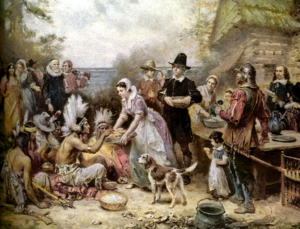
Thanksgiving celebrations are part of American history. Most elementary school children know the story of the first thanksgiving held at Plymouth Colony in 1621. There were wild turkeys on the menu, as well as venison and corn bread. Guests were members of the Wampanoag Nation, who also provided much of the food.
Two years later, when the colony was more secure, Governor Bradford issued a more official proclamation, noting that “Inasmuch as the great Father has given us this year an abundant harvest of Indian corn, wheat, peas, beans, squashes and garden vegetables, and has made the forests to abound with game and the sea with fish and clams, and inasmuch as He has protected us from the ravages of the savages, has spared us from pestilence and disease, has granted us freedom to worship God according to the dictates of our own conscience.
“Now I, your magistrate, do proclaim that all ye Pilgrims with your wives and your little ones, do gather at ye meeting house, on ye hill, . . . there to listen to ye pastor and render thanksgiving to ye Almighty God for all His blessings.”
Presumably, feasting began at noon. New Englanders took the custom to heart, holding annual celebrations, but there was no specific date or uniform observance. Merely thanks to God for continued bounty and safety followed by a feast. Specific menu items remain unclear.
President Washington’s National Proclamation
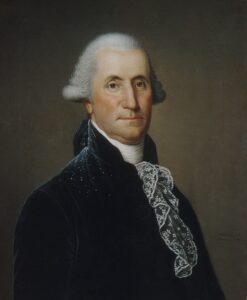
Localized Thanksgiving celebrations in states and townships continued, but it wasn’t until the Washington Administration that the entire nation celebrated an official Thanksgiving Day. Many events had taken place since 1623. In 1783 the Treaty of Paris between the new United States and Great Britain declared the United States to be a sovereign nation. In 1788, nine American states ratified the new Constitution establishing the national structure of government still in place today.
It was in this context, and in agreement with a congressional request, that President George Washington issued the United States’ first national proclamation of Thanksgiving on October 3, 1789, writing that he recommended and assigned “Thursday the 26th day of November next to be devoted by the People of these States to the service of that great and glorious Being, . . . That we may then all unite in rendering unto him our sincere and humble thanks . . . for the peaceable and rational manner, in which we have been enabled to establish constitutions of government for our safety and happiness, and particularly the national One now lately instituted–for the civil and religious liberty with which we are blessed . . .“
Washington proclaimed the first national Thanksgiving observance, but he did not make it an annual event. Time and history moved on. In 1861, the United States splintered into civil war.
Sarah Josepha Hale, Godmother of Thanksgiving
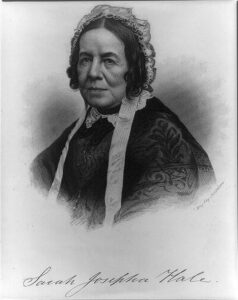
Today we might call Sarah Josepha Hale an Influencer. As a writer and editor of Godey’s Lady’s Book, she exercised tremendous public influence which she used to further various causes, such as white dresses as proper bridal attire.
In particular, Sarah Josepha Hale was obsessed with the idea of a common national holiday called Thanksgiving which she believed would unify the nation. Her commitment to the day grew when the United States split into civil war.
Hale campaigned for the holiday in her public writings, and reached out to politicians and others who could further her cause. On September 28, 1863, shortly after President Lincoln delivered his Gettysburg Address, Hale wrote the president informing him that “for some years past, there has been an increasing interest . . . to have the Thanksgiving held on the same day in all the States; it now needs National recognition and authoritative fixation only, to become permanently, an American custom.”
President Lincoln agreed with the concept. After the Union victory at Gettysburg In October 1863, the tide of the civil war began to turn. In this context, Lincoln proclaimed “In the midst of a civil war of unequaled magnitude and severity . . . order has been maintained, the laws have been respected and obeyed, and harmony has prevailed everywhere, except in the theater of military conflict; while that theater has been greatly contracted by the advancing armies and navies of the Union . . .
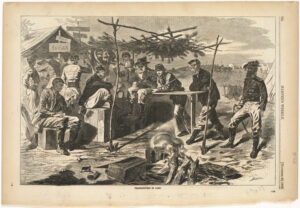
“I do therefore invite my fellow-citizens . . . to set apart and observe the last Thursday of November next as a Day of Thanksgiving and Praise . . . And I recommend to them that . . . they do also, with humble penitence for our national perverseness and disobedience, commend to His tender care all those who have become widows, orphans, mourners, or sufferers in the lamentable civil strife in which we are unavoidably engaged, and fervently implore the interposition of the Almighty hand to heal the wounds of the nation . . .”
Hale was pleased that there would be a single national day of Thanksgiving but disappointed Lincoln did not proclaim annual Thanksgiving as a fixed yearly event. Sarah continued her letter-writing campaign. She died in 1879 at the age of 90, but her dream continued.
In October 1941, the House of Representatives passed H. J. Res. 41 proposing an annual Thanksgiving on the last Thursday of November. Two months later, the Senate amended the resolution to specify the holiday occur on the fourth Thursday of November. The House agreed, and on December 26, 1941 President Franklin Roosevelt signed the resolution into law. Subsequently, American presidents have issued an annual Thanksgiving proclamation.
Pardoning the White House Turkey: An Annual Custom
Our current national custom of issuing a pardon to White House turkeys began in 1963 when President Kennedy spared a turkey presented to the White House by the National Turkey Federation. In 1987, President Reagan officially “pardoned” the White House turkey and sent it to a petting zoo. Two years later, President George H. W. Bush upgraded a simple pardon to a Presidential Pardon. The ceremony is now an annual event, and the pardoned turkeys live out their days in petting zoos, historic estates, and/or university agricultural programs such as Virginia Tech’s Gobblers Rest.
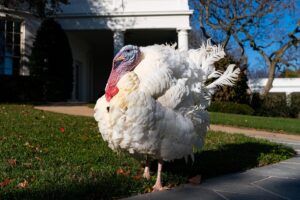
President Trump pardoned Corn in 2020.
HAPPY THANKSGIVING!

Illustrations & A Few Sources
The First Thanksgiving by Jean Leon Gerome Ferris; William Bradford by Unknown Author; George Washington 1795 by Adolf Ulrick Wertmüller; Sarah Josepha Hale 1881 by Unknown Author; Thanksgiving in Camp 1862 Harper’s Weekly; Trump Pardons Corn 2020. Rakashi Chand. Our National Thanksgiving. The Beehive. Nov. 20, 2023.
If you would like to be notified about out my blogs as they appear, sign up for my newsletter. In addition to the link to my latest blog, the newsletter includes news about my writing and publishing.