

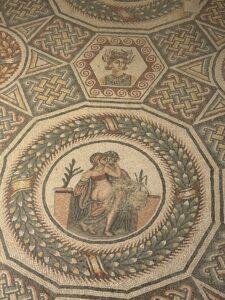
It’s hard to imagine the past. As an historian, my imagination can stretch as far back as the 18th century. With a little extra creativity, I can reach the 17th century. But earlier times are elusive unless I can connect with the material culture to build a bridge that connects to the distant past. I think this is why traveling to distant locales is such an important part of my life.
This year I escaped to Sicily and southern Italy, places I’ve never been before, and hiked through extreme heat to visit sites connected to Ancient Rome and Greece. The sites did not disappoint. One of them was the Villa Romano Del Casale.
Located on Sicily, the Villa Romano is a World Heritage site built in the middle of the fourth century. The villa’s claim to fame rests on its well-preserved and extensive Roman mosaics covering about 3500 square meters, as well as frescoes on the exterior walls and interior rooms. The site continued to be in use until a landslide in the mid-12th century covered the villa. Though some evidence of the past was visible above ground, the area was used for crop cultivation. The first professional excavations took place in 1929, and have continued over the years since.

The villa was probably a hunting lodge until the Romans partitioned much of the Sicilian hinterland into agricultural estates called latifundia. The Villa Romano was one of these. The landowner in his role of patron needed a place to receive clients. Multiple reception and state rooms were also needed as well as private apartments for the owner and his family. African artisans are credited with designing and installing the mosaic floors.
Over time, the villa expanded along three terraces organized around three axis. The first terrace with private apartments, teh basilica, and the Corridor of the Great Hunt is in the east. The next terrace has a dining area and an oval courtyard, accessible from the Corridor of the Great Hunt. The third terrace includes baths and a large entrance area.
Coronation of the Winner
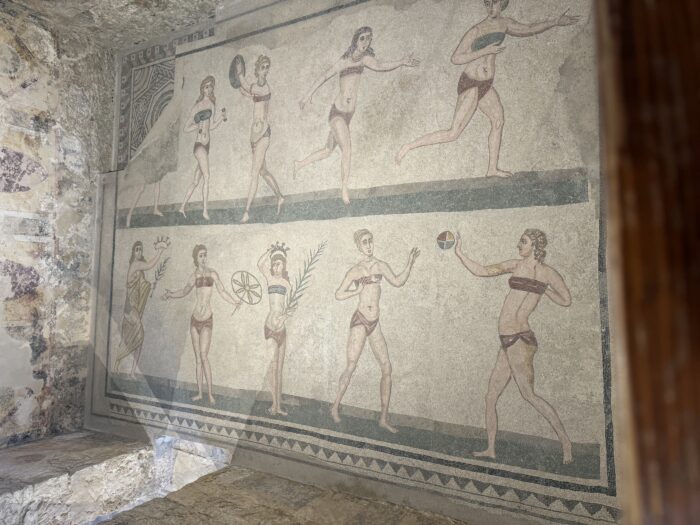
One fresco is surprisingly well-known. Called Coronation of the Winner, the fresco depicts female athletes competing in contests that are usually interpreted as weight lifting, discus throwing, running, and batting a ball. An official on the bottom left of the picture holds the trophy crown and palm frond. At the center of this panel, the victor is crowned. Some modern viewers fixate on the contestants’ athletic attire, comparing the two-piece ensemble to contemporary swim wear. It strikes me the athletes were more interested in modesty and ease of motion.
Corridor of the Great Hunt
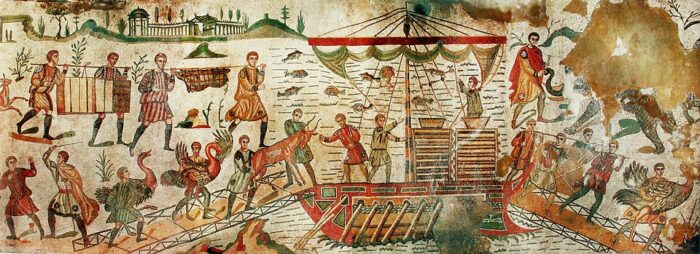
The Corridor of the Great Hunt, probably created in the year 330 AD, is the 197 feet long, the longest extant mosaic from the Roman Empire. The entire floor is covered with images of the hunt to capture exotic animals from Africa and bring them to Rome for display. Carthage is pictured as the departure port where animals were loaded onto a boat known as a navis with both sails and oars for transport to Rome where they are offloaded at the nearest port.
Illustrations & A Few Sources
Erotic Scene Mosaic, Photo by Author; Villa del Casale Plan, Public Domain; Coronation of the Winner, Photo by Author; Exotic Animal Transportation, Public Domain; Mosaic Bird, Photo by Author. Patrizio Pensabene and Enrico Gallocchio. “The Villa Del Casale of Piazza Armerina.” Expedition Magazine, vol 53, No 2. 2011.
If you would like to be notified about out my blogs as they appear, sign up for my newsletter. In addition to the link to my latest blog, the newsletter includes news about my writing and publishing.
Hi Sandra,
What fun! Sounds like a great trip! Amazing blog as many of them are, so informative along with the photos. Yes, perhaps it is modesty with the women athletes, you know more of the prior years than I do, I was just impressed that they had freedom of clothing which changed with the English and their religion and the Christianity marches (I am guessing that is when things started changing). Much later with the Inquisition. Thank you much! Paula
So glad you enjoyed the blog. I too was surprised by the fresco of female athletes. The fresco has become quite famous, but I don’t know how widespread the practice was.