

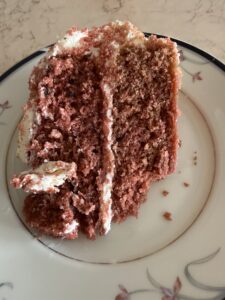
Earlier this month, I baked a Red Velvet Cake from scratch. Judging by the number of recipes on-line, this is a very popular cake. I eventually settled on a recipe from Sally’s Baking Addiction, which turned out to be a good choice. I was a bit surprised by some of the ingredients, such as unsweetened cocoa powder, white vinegar, and buttermilk. Red gel food coloring seemed an obvious addition since I was pretty sure red velvet fabric would not be good in a cake.
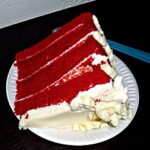
On the left is a picture of the first slice from the cake I baked. And it’s fair to say I’m not going to switch careers to become a baker. As a contrast to share what a Red Velvet Cake can look like, I offer the photo on the right. Two aspects that stand out are the brilliant red color, and the four layers.
Still, I enjoyed the process and learned a few things while putting together the cake, one of which was where the switch for my mixer is. Another, that I don’t separate eggs as well as I once did.
What I Learned About Cakes
During the 18th and early 19th centuries, cakes were heavy. A pound cake, for example weighed four pounds, because the ingredients were a pound each of butter, flour, sugar, and eggs. Today pound cakes are smaller, but still somewhat hefty. In fact, other than sugar there wasn’t a huge difference of texture between cakes and bread. The use of white flour became more common after 1850.
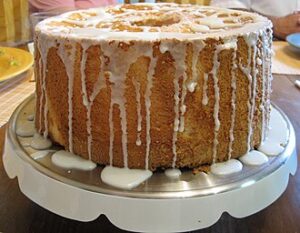
Sponge cakes were an alternative to pound cakes. Angel Food Cake, so light it reminded people of angels or less happily, aching arms and shoulders from whipping egg whites, was a popular cake with a more velvet crumb.
A recipe for Suffrage Angel Cake from a 1915 suffrage cookbook reads as follows.
- 11 eggs
- 1 full cup Swansdown Flour (after sifting)
- 1-1/2 cups granulated sugar
- 1 heaping teaspoon cream of tartar
- 2 teaspoons vanilla
- 1 pinch of salt
Beat the eggs until light, not stiff; sift sugar 7 times, add to eggs, beating as little as possible. Sift flour 9 times, using only the cupful and discarding extra flour; then put the cream of tartar into the flour. Add mixture to eggs and sugar. Now add vanilla. Put in angel cake pan with feet. Put in oven with very little heat. Great care must be used in making this cake to insure success.
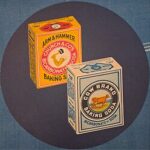
Aside from egg whites, another way to bake a lighter cake was to use almond flour, cocoa or cornstarch to soften the proteins of regular flour, giving it the consistency of velvet. Other products also became available. In 1846, baking soda appeared. When combined with acids found in vinegar or buttermilk, it produced carbon dioxide for a cake with instant leavening. But it was hard to know how much acid was in the buttermilk or vinegar being used.
Baking powder made from acid mixed with baking soda appeared in 1856. When added to liquid, the baking soda and acid in the powder caused carbonation. [Sidebar: This reminds me of the little plastic frogmen children got from cereal boxes in the 1950s. When baking powder was placed in the reservoir, the frogmen would sink to the bottom of a bucket of water and then resurface. Ah, simpler times. But I digress.]
Once Upon a Time . . .

In 1888, John A. Adams launched a food flavoring company featuring products like Adams Best, a vanilla flavor. He was inspired by his wife who wanted a flavoring that could tolerate baking and freezing. In 1905 for reasons I don’t know, Adams moved his family to Beeville, Texas, near Corpus Christi, and began selling his flavors door-to-door. In 1922, Adams’ son Fred relocated the business to Austin. Twenty-five years later, his son John G. Adams took over the business, now called the Adams Extract Company.
Dessert at the Waldorf-Astoria
On October 1, 1931, the “new” Waldorf-Astoria on Park Avenue opened its doors. The Art Deco hotel covered an entire city block and was the tallest, most expensive hotel in the world. Maître d’ hôtel Oscar Tschirky introduced well-known dishes like Eggs Benedict and Waldorf salad. The hotel also famously served Red Velvet Cake, though it did not create the recipe.
It was said that one patron asked for the recipe. The chef graciously shared directions for creating the cake, and added a high charge to the bill. The customer was outraged, and demanded a refund, which the chef refused. In retaliation, the customer spread the recipe. There is no record that this actually happened, but the rumor led to Red Velvet Cake becoming known as the “$100 cake.”
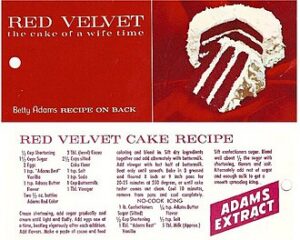
However, in 1947 John Adams and his wife Betty dined at the Waldorf Astoria and had Red Velvet Cake for dessert. The experience inspired Betty Adams to create a similar cake using red food dye, vanilla extract, and butter flavoring. The latter because in the wake of World War II, butter was still being rationed. The result was a marketing campaign: the Red Velvet Cake Kit with a bottle of red dye, a bottle of vanilla extract, and an accurate recipe card. Red Velvet Cake left fine dining establishments and moved to the American kitchen.
Back to my Kitchen

So, I started with Sally’s recipe from Sallys Baking Addiction which promised the cake would be dense, soft, moist, and have a velvety crumb. It would also have cream cheese frosting, my favorite. I’m not going to copy the recipe here. Go to Sally’s Baking Addiction for the full recipe and preparation process. Or you can check out Sally’s YouTube.
I checked the ingredients and went to the local grocery store. Sally uses cake flour which is lighter than regular flour, so you don’t have to spend a hour sifting it. There is unsweetened cocoa powder. There’s also buttermilk which isn’t very popular these days. I had to go to a second store for that, but it’s a necessary ingredient to activate the baking soda. And, of course, the red gel coloring.
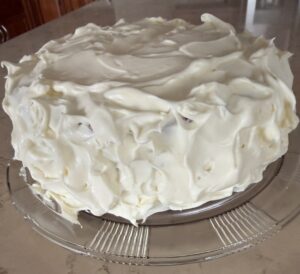
The recipe also requires 4 large eggs, separated. Sadly, some naughty yolk snuck into the white, so the whites didn’t whip up like they were supposed to with the result my cake was less velvety than it might have been. But it still came out pretty well.
To the left is a picture of my completed Red Velvet Cake standing on a genuine nostalgic 1950s cake platter. She lacks glitter, and the cream cheese frosting looks a bit haphazard, but the important thing is that after a long time thinking of the kitchen as a room to pass through on the way to the door, I managed to produce a tasty cake.
🥮 🥮 🥮 🥮 🥮
Illustrations & A Few Sources
Red Velvet Cake Slice by Author; Red Velvet Cake, 4 layers by Flickr user~Twon~; Angel Food Cake by Kimberly Vardeman; Baking Soda, 1938; Adams’ Logo. Adams’ Recipe Card. Broken egg on black surface by Balise42. Velvet Cake by Author. L. O. Kleber.
Sally McKenney. “Red Velvet Cake with Cream Cheese Frosting“. Sally’s Baking Addiction. Suffrage Cook Book. Equal Franchise Federation of Western Pennsylvania. 1915. “Dye Hard: A History of Red Velvet Cake.” Part 1. Adventures in Taste & Time. Mar. 7, 2020. “Ibid., Part 2, Apr. 7, 2020.
If you would like to be notified about out my blogs as they appear, sign up for my newsletter. In addition to the link to my latest blog, the newsletter includes news about my writing and publishing.
Update: still using this after 3 months and im even more impressed now, the platform has been super stable with no crashes and the experience keeps getting better. 777 solt has definitly earned my trust as a long-term option.