

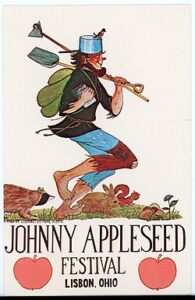
In the early 19th century, Johnny Appleseed planted seedling apple orchards across the midwest. And as the crops came in, the small, bitter apples were pressed into cider. Meanwhile, farmers found it easier to distill whiskey than ship their grain overland. With whiskey priced at about 25 cents per gallon, whiskey and cider were cheaper than coffee or tea; they were safer to drink than water or milk. Alcohol also served as currency at a time when each state regulated its own money supply.
Estimates of alcohol consumption in 1830 put the total personal average of 5 gallons of distilled liquor annually, and 15 or more gallons of hard cider. If men consumed the majority of liquor, the figure works out to 4-5 shots daily.
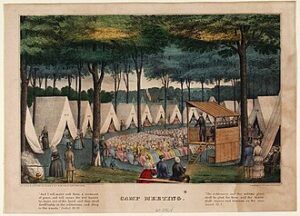
But, about 1830 American culture experienced a broad movement for social reform. A rebirth of religious zeal known as The Second Great Awakening, inspired social reform movements, including a national campaign against alcohol consumption. The American Temperance Society founded in 1826, urged Americans to practice self-control around alcohol. Social reformers identified excessive drinking as the root cause of domestic violence, abuse, poverty, crime, moral decay, and political corruption.
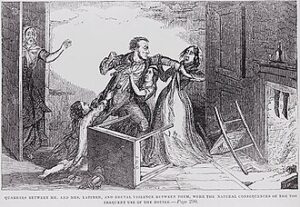
The initial goal of limiting alcohol consumption became a campaign for total abstinence of both spirits and hard cider. “It takes a long time to make a man a drunkard on cider, but when made, he is thoroughly made, is lazy, bloated, stupid, cross and ugly, wastes his estate, his character, and the happiness of his family.”
Once a source of prosperity, seedling apple trees became the cause of social disaster. One reformer argued that if a farmer gathered his apples, he must make them into cider. Thus, the only true pathway to reform was to burn the orchards.
William Henry Harrison: The Log Cabin & Hard Cider Candidate
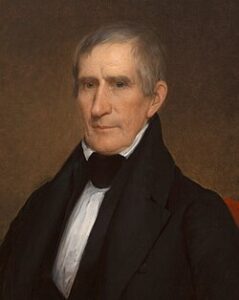
As this social reform debate raged, Americans went to the polls in the 1840 presidential election. The candidates were Democrat Martin Van Buren running for re-election and Whig William Henry Harrison. The candidates had met before in 1836 when Harrison lost. But as Van Buren campaigned for a second term, Harrison supporters blamed Van Buren for the economic Panic of 1837, and called him Van Ruin.
Van Buren’s people dubbed Harrison Granny Harrison, an out of touch, possibly senile man who would rather sit on the porch outside his log cabin and drink cider. Harrison’s people turned what the Van Buren supporters thought was an insult, into the image of an American frontiersman who understood the needs of the common man.
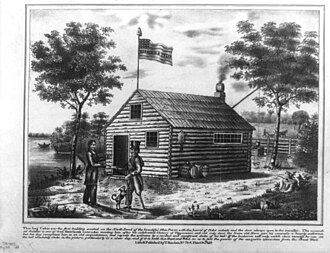
The contrast between the elitist Van Buren and the homespun Harrison placed the two candidates in stark contrast and also introduced new popular campaign tactics. Harrison became the Log Cabin and Hard Cider Candidate, a true man of the people. [In the illustration at left, note the barrels of cider leaning against the log cabin.]

He was the first candidate to hit the campaign trail with mass rallies featuring free food and barrels of cider. Harrison’s campaign was the first to feature mercandise, including tea cups and saucers. Harrison’s campaign slogan Tippecanoe and Tyler Too reminded voters of Harrison’s military battles against Native Americans while also bringing Tyler national attention in an appeal to southern voters. In many ways, Harrison launched the first modern presidential campaign, and he did it one barrel of cider at a time.
When the votes were counted, Harrison received 234 electoral votes in comparison to Van Buren’s 60. Harrison won the popular vote 1,275,390 : 1,128,854. On March 4, 1841, Harrison gave an inauguration speech that lasted almost two hours. Harrison died of pneumonia about a month later on April 4, 1841.
Meanwhile, the Temperance Movement picked up speed between 1840 and 1860. By the time the American civil war began, alcohol consumption per person had dropped to about 2.5 gallons per person, about what it is today.
Illustrations & A Few Sources
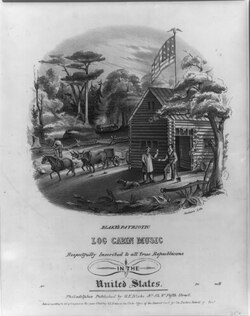
Johnny Appleseed Festival, Lisbon, Ohio; Revival by Kelloggs & Comstock 1849; Drunkard Hitting His Wife, 1871; William Henry Harrison by Albert Gallatin Holt; Harrison at Cabin in North Bend of Ohio, 1840; Log Cabin Tea Cup with Saucer; Log Cabin Music 1840. Daniel De Visé. “Americans are Drinking as Much Now as in Civil War Days.” The Hill. June 12, 2023. Adalyn Schuenemeyer. “Burn Them! A Myth of Cider, Orchards & Prohibition.” Montezuma Orchard. Jan. 14, 2021.
If you would like to be notified about out my blogs as they appear, sign up for my newsletter. In addition to the link to my latest blog, the newsletter includes news about my writing and publishing.