

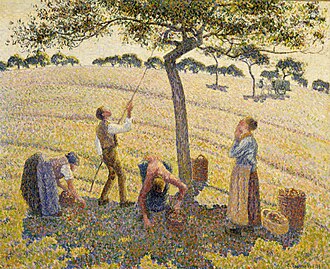
In the northern hemisphere, fall is Harvest Time. Pumpkins & winter squash, sweet potatoes, root vegetables, and various fruits, including pears, grapes, cranberries, figs & pomegranates. But today, my focus is on apples.
Seventeenth century apples bore little resemblance to the many apple varietals we harvest today. The Puritans brought apple seeds with them when they migrated, but the apples the seedling trees produced were small and often too bitter to eat. The fruit, however, was good for making cider, which quickly became the standard colonial beverage.
Water was often unsafe to drink, and grains used for brewing beer were difficult to cultivate. Cider, on the other hand, was consumed by all ages at every meal. [A weaker cider, called ciderkin, was served to children.]
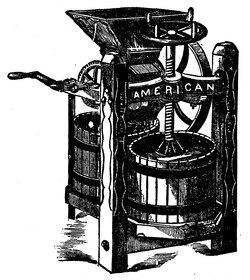
In the autumn, colonists gathered seedling apples and crushed them into a pulp which was placed in a wooden screw press and pressed to extract the raw juice. The juice went into large wooden barrels where naturally occurring yeast on the apple skins fermented the sugars into hard cider. A large family might put up 100 barrels of cider to tide them over the winter. [Each barrel held 31.5 gallons of cider.]
Colonists produced applejack by leaving the cider outside during the winter. Water in the cider became ice, and was easily removed, leaving a more potent cider. The process could be repeated six or seven times with each cycle producing a more potent beverage. Fermenting the hard cider also produced apple cider vinegar which colonists used to preserve vegetables by pickling.
Colonists kept barrels of cider throughout the winter for direct consumption and for use as currency to pay taxes, wages, and church tithes.
American Alcohol Consumption
By the 18th century, Americans consumed large quantities of alcoholic beverages. Per capita annual intake in 1790 is estimated at 34 gallons of beer and cider; 5 gallons of distilled spirits, and about a gallon of wine. Alcohol was served at christenings, weddings, funerals, trials, and on election days. Candidates could not bribe voters, but there was no harm in a celebration on the way to the polls.
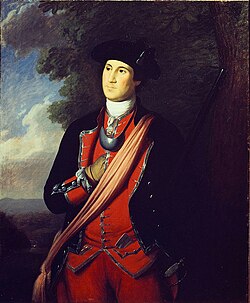
George Washington disapproved of serving liquor as a way to entertain voters. In 1755 when he ran for the Virginia House of Burgesses, he failed to provide refreshments and lost 271:40. When Washington ran again in 1758, he treated voters to 28 gallons of rum, 50 gallons rum punch 34 gallons of wine, 46 gallons of beer, and 2 gallons of cider royal, which equates to about half a gallon of alcohol per voter. Washington received 331 votes, and won the election.
Interestingly, when he died in 1799, Washington had the largest distillery in Virginia, producing 10,500 gallons of whiskey and brandy each year.
Other prominent Founding Fathers also enjoyed their alcohol. John Adams began the day with a tankard of hard cider. John Hancock was accused of smuggling wine. Samuel Adams managed a brewery. Thomas Jefferson called his Taliaferro cultivar the “best cider apple existing.” Alcohol consumption was part of American life, and the alcohol most frequently consumed was hard cider.
As Benjamin Franklin observed in Poor Richard’s Almanac:
“He that drinks his cider alone, let him also catch his horse alone.”
The Myth of Johnny Appleseed
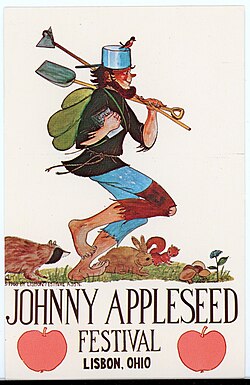
In 1948 Walt Disney Productions released a film called Melody Time featuring seven stories. One of these stories was the Legend of Johnny Appleseed, based on stories about John Chapman, an itinerant farmer who planted apple trees throughout the Midwest.
In Disney’s version of the story, a young farmer tends his apple orchard and wishes he could follow Americans migrating to the frontier. One day an angel appears and tells Johnny to leave his farm, go west, and plant apple seeds so settlers will always have something to eat as they follow the trail. Johnny listens to the angel, and begins starting apple orchards. He also befriends a skunk after which all the animals trust him. Eventually, the trees mature and are a blessing for the pioneers.
The Rest of the Story
Disney may have embellished John Chapman’s biography, but the legend was based on facts. Chapman, generally remembered as Johnny Appleseed, did plant apple trees in Pennsylvania, Ohio, Indiana, and Illinois. He was known for his kindness. He carried a sack of apple seeds and a Bible. And he wore a tin pot for a cap. He also walked in bare feet.
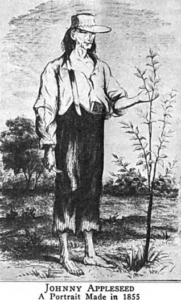
Some of Johnny’s inspiration came from the Ohio Company of Associates. In 1792 the company offered anyone who built a permanent homestead in the wilderness beyond Ohio’s first permanent settlement 100 acres of land. To prove their claim, settlers had to plant 50 apple trees and 20 peach trees over the course of 3 years. A seedling apple tree took about 10 years to bear fruit.
Johnny deduced that if he planted the orchards, he could sell them at a profit to arriving settlers. When Johnny arrived at a site, he acquired land and established nurseries. When the settlers arrived, Johnny sold them his young trees for 6-1/2 cents each. Since it cost him nothing to grow the trees, and he sold thousands of the plants, he made a clear profit. The small, bitter apples were not worth eating, but they could be pressed into either hard cider or an applejack of up to 66 proof.
As the 19th century progressed, American culture changed, and apple cider, once a mainstay of American life, fell out of favor. Details in my next blog.
🍎 🍎 🍎 🍎 🍎 🍎 🍎
Illustrations & A Few Sources
Apple Harvest by Camille Pissarro 1888; Cider Mill 1897; George Washington in 1754 by Ernest Fischer; Johnny Appleseed Festival, Lisbon, Ohio; Johnny Appleseed 1855. Sam Kean. “The Debaucherous Legacy of Johnny Appleseed.” The Disappearing Spoon Podcast. Oct. 18, 2022. Ed Crews. “Drinking in Colonial America.” Colonial Williamsburg.
If you would like to be notified about out my blogs as they appear, sign up for my newsletter. In addition to the link to my latest blog, the newsletter includes news about my writing and publishing.